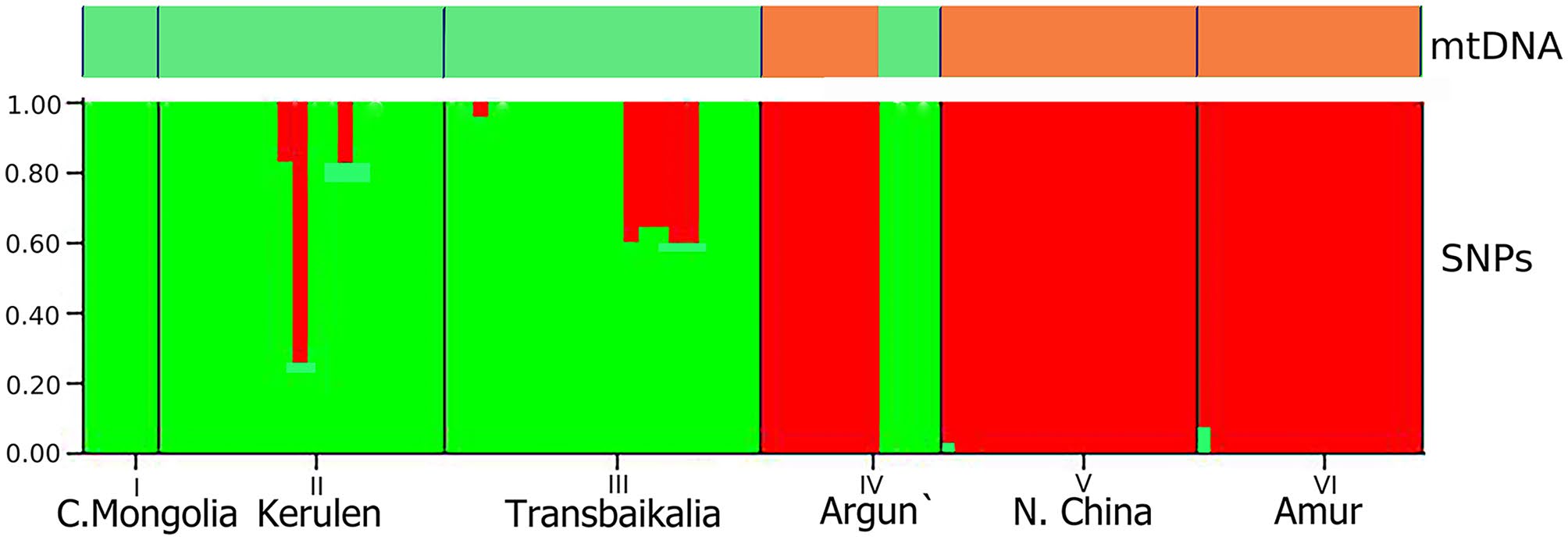
ddRAD raw data for Pica pica (Aves: Corvidae) - Additional material (raw data of the ddRAD analysis) to Kryukov et al. (2022): "Introgression at the emerging secondary contact zone of magpie Pica pica subspecies (Aves: Corvidae): integrating data on nuclear and mitochondrial markers, vocalizations, and field observations"
| DOI: | https://doi.org/10.57756/ftktbx |
|---|---|
| Creator(s): |
|
| Publication date: | 10 Jun 2026 |
| Publisher: | Naturhistorisches Museum Wien (NHMW) |
| Collections: | Central Research Laboratories |
| Resource type: | Text |
| License: |

CC BY 4.0 International |
| Tags: | Ddrad analysis Genetics Pica pica Population genetics |
| Countries: |
|
| Taxa: | Passeriformes |
| Share: |
|
 https://orcid.org/0000-0002-5411-1879
Abstract
Raw ddRad dataset and SNP dataset for the paper by Kryukov et al. (2022): "Introgression at the emerging secondary contact zone of magpie Pica pica subspecies (Aves: Corvidae): integrating data on nuclear and mitochondrial markers, vocalizations, and field observations"
Usage Notes
Genomic DNA was extracted from blood, feather, or muscle samples with DNeasy Blood & Tissue Kit (Qiagen). After preliminary quality control on a fluorometer (Qubit 2.0 Fluorometer, Invitrogen, Carlsbad, CA), we sent 1–10 μg per DNA samples at concentrations ranging from 30 to 330 ng/μl to IGATech (Italy). ddRAD libraries were produced by IGATech following Peterson’s doubledigest restriction site-associated DNA preparation protocol (Peterson et al., 2012) with modifications. Enzyme combinations were preselected by in silico analyses of restriction sites based on three closely related species: Corvus cornix (GCA_000738735.2_ASM73873v2_genomic.fna and GCA_002023255.2_ASM202325v2_genomic.fna), C. brachyrhynchos (GCA_000691975.1_ASM69197v1_genomic.fna), and C. hawaiiensis (GCA_003402825.1_Coha_1.0_genomic. fna). Concentrations of genomic DNA were fluorometrically quantified and then normalized. After that, 300 ng was double digested with 2.4 U of both PstI and EcoRI endonucleases (New England BioLabs) in 30 μl reaction supplemented with CutSmart Buffer and incubated first at 37 °C for 90 min and then at 65 °C for 20 min. Fragmented DNA was purified with 1.5 volumes of AMPureXP beads (Agencourt) and subsequently ligated with 200 U of T4 DNA ligase (New England BioLabs) to 2.5 pmol of overhang barcoded adapter for rare cut sites and to 5 pmol of overhang barcoded adapter for frequent cut sites in 50 μl reaction. These samples were incubated at 23 °C for 60 min and at 20 °C for 60 min followed by 20 min at 65 °C and subsequently pooled in multiplexed batches and bead purified as described before. For each pool, targeted fragment length distribution was evaluated on a Blue- Pippin instrument (Sage Science Inc.) and only fragments within the range of 530–650 bp were used for sequencing. Gel-eluted DNA fragments were amplified with indexed primers to increase the DNA volume for sequencing using Phusion High-Fidelity PCR Master Mix (New England BioLabs) in a final volume of 50 μl and subjected to the following thermal protocol: [95 °C, 3 min] − [95 °C, 30 s −60 °C, 30 s −72 °C, 45 s] × 10 cycles − [72 °C, 2 min]. Products were purified with 1 volume of AMPureXP beads. The resulting libraries were checked with both Qubit 2.0 Fluorometer (Invitrogen, Carlsbad, CA) and Bioanalyzer DNA assay (Agilent technologies, Santa Clara, CA) prior to paired-end sequencing with 125 cycles on a HiSeq 2500 sequencer following the manufacturer’s instructions (Illumina, San Diego, CA). This yielded a total of 241,818,224 raw sequences. Pools were demultiplexed to individual FASTQ files by removing barcode sequences and by trimming to a final length of 110 bp using Stacks v.2.0 (Catchen et al., 2013). Paired-end reads (110 bp) were then clustered to define reference locus sequences for each fragment flanked by two restriction sites using the de novo pipeline from the Stacks package with default parameters. Each locus thus represents a 220-bp-long sequence, which was obtained by clustering reads in pairs. The size selection prevents overlap between each pair and eventually reduces the number of sampled bases per locus. Using the “populations” tool of Stacks, we retained loci that were successfully genotyped in at least 75% of the samples. For 28,292 genotyped loci, we assembled paired-end contigs and merged them with the single-end locus, aligned reads to the locus, and called SNPs. Overall, 135,872 polymorphic sites were obtained and stored as VCF and other file types for downstream population genetics analyses.
Meta-information for each sample in the VCF file populations.snps_filtered.vcf.gz, which contains polymorphic sites from ddRAD seqencing, can be found in the corresponding Excel Table SampleSheet_Plate_Pica_20180704.xlsx.
Information on the sequencing protocol, the ddRAD library preparation and bioinformatic analyses can be found in the document ddRAD_README.pdf).
Publications
Downloads
| File | Description | Size |
|---|---|---|
| populations.snps_filtered.vcf.gz | Polymorphic sites from ddRAD seqencing (gzip-compressed VCF file) | 71.44 MB |
| SampleSheet_Plate_Pica_20180704.csv | Sample details (MS Excel format) | 1.09 MB |
| SampleSheet_Plate_Pica_20180704.xlsx | Sample details (CSV format) | 0.04 MB |
| sequences.zip | Raw ddRad sequences (zipped folder with paired-end reads in FASTQ format) | 13192 MB |
| stacks.zip | Raw data output of the Stacks software (zipped folder) | 329.04 MB |
Media
Images